








LEIPS Equipment Introduction
What is LEIPS?
In 2012, Dr. Hiroyuki Yoshida of the Institute for Chemical Research, Kyoto University(Currently a professor at Chiba University⇒Web site)がUsing the newly developed Low-Energy Inverse Photoemission Spectroscopy (LEIPS) method, it has become possible for the first time in the world to directly measure LUMO levels with high precision.
Our company has concluded a “License Agreement” for the intellectual property with Kyoto University (Kansai TLO Co., Ltd.) and has commercialized the technology.。
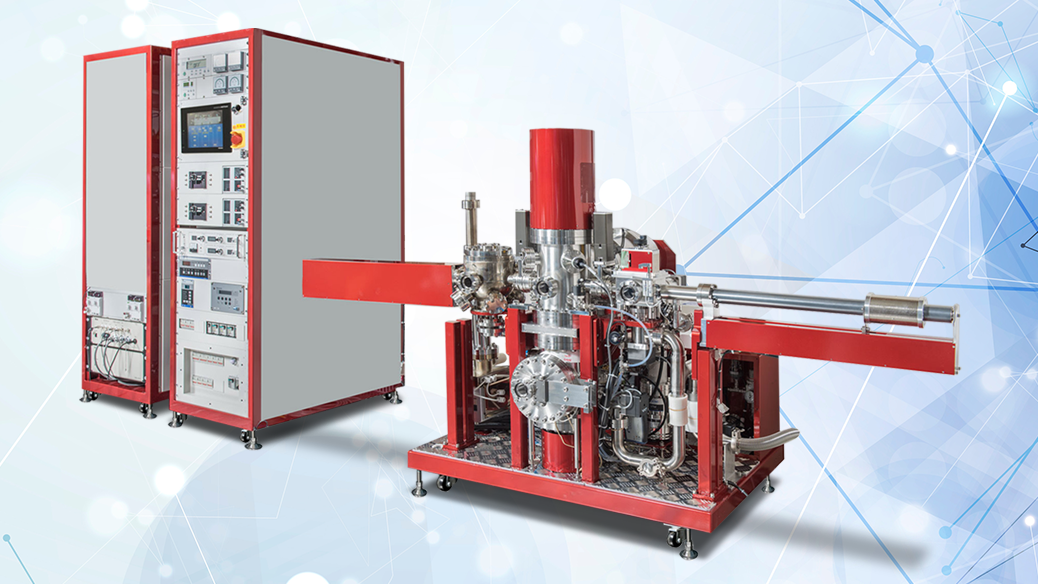

Features of the LE-1
By lowering the energy level of the back-scattered electron spectroscopy method, we have achieved high-precision measurement of the LUMO level (electron affinity).

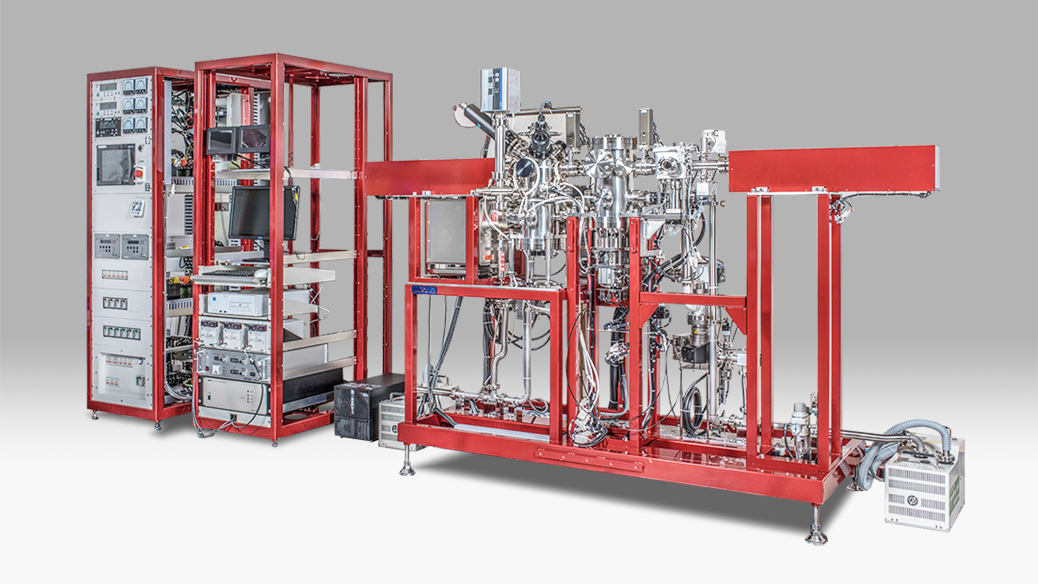
Significant reduction in sample damage
●The kinetic energy of incident electrons is kept below 5 eV, the damage threshold for organic molecules.
High-Precision LUMO Level Measurement
●Capable of measuring thin-film samples identical to devices.
●Directly measures electrons relaxed to conduction-related levels.
●Achieves precision equivalent to photoelectron spectroscopy (XPS, UPS).
●Energy resolution below 0.5 eV. Reproducibility below 0.1 eV.
●Measured optical spectra reflect the density of states.
Simple Device Operation
●Despite ultra-high vacuum specifications (10⁻⁸ Pa range), sample loading, pumping, and measurement are automated via simple touch panel operation.
● Efficient measurements are possible by stocking four sample substrates (buffer chamber).
Simple Measurement Operation
● The standard LEIPS software enables automatic measurements and electron affinity calculations with simple operation.
Convenience and expandability
●Standard compatibility with docking for photoelectron spectroscopy (XPS, UPS) and expansion of evaporation systems.
●Standard carrier box equipped for sample substrate transport without atmospheric exposure.
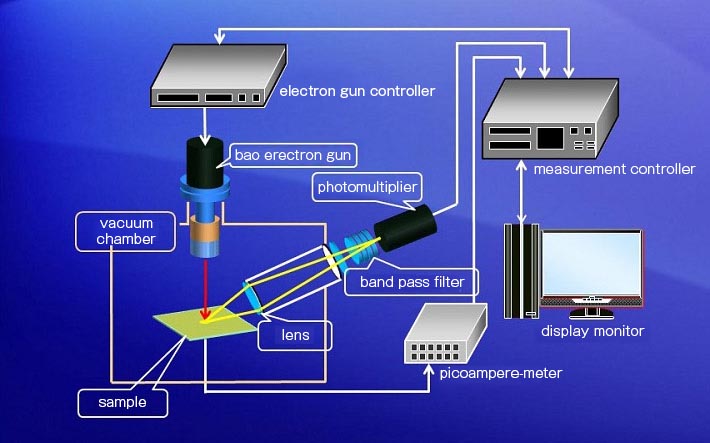
Detects near-ultraviolet light with incident electron kinetic energy approximately 5 eV or less.
●Avoids damage to organic samples.
●Enables the use of high-sensitivity photomultiplier tubes.
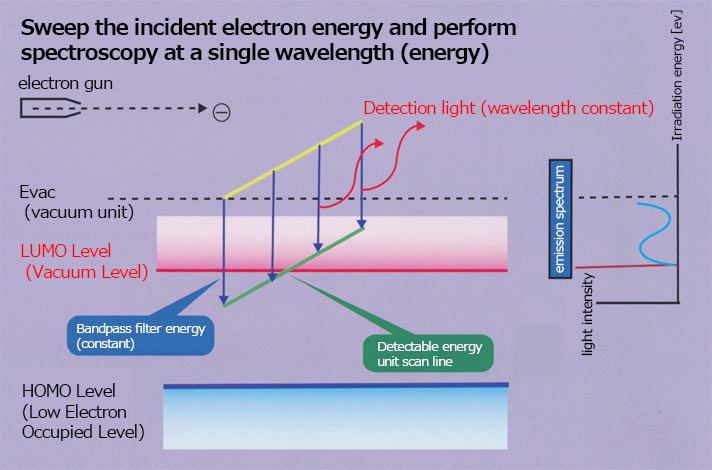
●Adoption of isochromatic mode enables spectroscopy using high-sensitivity, high-energy-resolution dielectric multilayer bandpass filters.
●High energy resolution BaO cathode adopted for the electron gun.
LEIPS Measurement Configuration Diagram
Specifications
| Item | Conventional IEIPS | LEIPS | |
|---|---|---|---|
| Kinetic energy of the incident electrons | 5~15 eV | ≤ 5 eV | |
| Detection wavelength | ultraviolet light | near-ultraviolet light (200~400nm) | |
| light detector | Filter | SrF2,CaF2 etc. | Bandpass filter |
| Detection energy |
≥ 10eV | ~5eV | |
| Energy resolution | 0.4~0.8eV | ~0.2eV | |
| Detection sensitivity |
low | expensive | |
| electron gun | Cathode material |
W etc. | BaO |
| Energy Bandwidth |
0.6~0.7 | ~0.3eV | |
| System resolution |
0.7~1.1eV | ≤ 0.5eV | |
| System sensitivity |
low | expensive | |
| Damage to organic materials |
Serious | not observed | |
Backlight Electron Spectroscopy (Isochromat Mode)
LEIPS software included as standard equipment
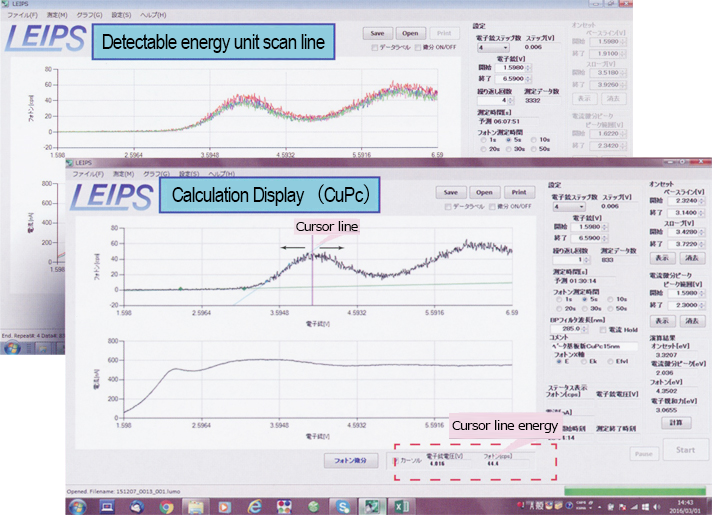 LEIPS Software
Simple operation
● Simply input measurement conditions and start to automatically measure the sample current spectrum and LEIPS optical spectrum.
● Calculate vacuum levels and electron affinities with simple operations on the calculation screen using the measurement results.
User-Friendly
● Call up the cursor on the calculation screen to instantly convert and read energy values at any point into either incident electron energy or energy relative to the vacuum level.
● Measurement data is automatically saved in CSV format for customer analysis and use.
Dr. Hiroyuki Yoshida of the Institute for Chemical Research, Kyoto University (currently Professor at Chiba University⇒Web site)
Contact Us
Please feel free to contact us via the form below for any inquiries or questions.
